Sealless Magnetic Drive Pumps
Sealless magnetic drive pumps are designed for liquid-handling duties where leakage prevention is a core engineering requirement, not a secondary benefit. In systems carrying hazardous, toxic, flammable or environmentally sensitive liquids, the rotating shaft seal in a conventional pump arrangement is often the most exposed path to atmosphere. A sealless magnetic drive pump removes that seal from the power transmission concept and instead uses magnetic coupling to transfer torque while keeping the pumped liquid contained within the pressure boundary.
For operators in marine, industrial and energy applications, this has direct implications for safety, uptime and lifecycle cost. Whether the duty involves ammonia, methanol, ethanol, hydrocarbons, glycol mixtures, amine-water blends or other clean process liquids, containment affects both risk management and long-term maintainability. DESMI supports this area with proven pumping technology, application-focused engineering dialogue and technical documentation that helps engineers, project teams and purchasers specify the right solution for leak-sensitive service.
What is a magnetic drive pump and when should you use one?
If the question is “What is a magnetic drive pump?”, the short answer is that it is a pump in which torque is transmitted from the motor to the pump shaft through a magnetic coupling rather than through a direct shaft connection with a rotating mechanical seal. In a conventional sealed pump, the shaft passes through the casing and requires a dynamic seal to keep the liquid inside. In a magnetic drive pump, that rotating seal to atmosphere is eliminated, and the liquid remains enclosed behind a hermetic containment barrier.
This difference is not only mechanical - it affects where and why the technology should be used. A sealless mag drive pump is often the right choice when leakage prevention outweighs the simplicity of a standard sealed arrangement. Typical decision drivers include hazardous liquid service, flammable media, emission-sensitive duties, difficult access for seal maintenance, and systems where recurring seal wear would create avoidable lifecycle cost.
In practical terms, you should consider a magnetic drive chemical pump when the duty involves clean liquids and stable operating conditions, but the consequences of leakage are high. This is often the case in marine fuel systems, ammonia recovery units, chemical circulation loops, coolant systems and hydrocarbon transfer service. It can also be the right option when plant designers want a compact, enclosed pump arrangement with reduced seal-related intervention over time.
Typical reasons to choose a magnetic drive pump:
-
No rotating shaft seal to atmosphere
-
Reduced leakage risk in hazardous or environmentally sensitive service
-
Lower exposure to seal wear and seal replacement work
-
Good fit for clean-liquid transfer and circulation duties
-
Strong relevance in alternative-fuel and chemically regulated environments
Magnetic Drive Pump working principle
The working principle is straightforward, but the details matter. In a magnetic drive pump, the motor turns an outer magnet assembly mounted on the motor shaft. This outer magnet transmits torque through a hermetic canister to an inner magnet assembly mounted on the pump shaft. Because the canister forms a sealed barrier between atmosphere and the wetted area, torque is transferred without direct shaft penetration.
The pump shaft then drives the impeller. In a centrifugal magnetic drive pump, liquid enters axially at the suction side and is accelerated radially outwards by the impeller. The hydraulic energy is converted into pressure in the pump casing, creating the required flow and head.
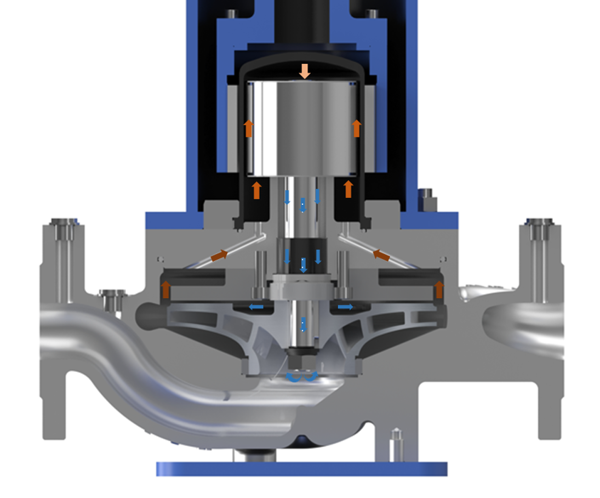
Sealless magnetic drive pump working principle illustrating magnetic coupling technology and leak-free fluid handling.
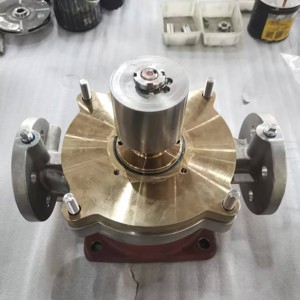
Installation of the inner magnet rotor, which transfers torque through magnetic coupling without requiring a mechanical shaft seal.
The internal construction typically includes:
-
Outer magnet mounted on the motor shaft
-
Inner magnet mounted on the pump shaft
-
Hermetic canister between the magnet assemblies
-
Shaft and impeller for torque transfer and hydraulic work
-
Sliding bearings for radial loads
-
Thrust bearings for axial loads
-
O-rings and static sealing interfaces between the main components
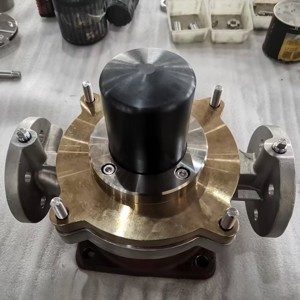
Installation of the containment canister, which creates the sealed barrier between the magnetic coupling and the process fluid.
The pumped media plays an important role in reliable operation. Sliding bearings and thrust bearings are cooled and lubricated by the pumped liquid through internal circulation paths inside the pump. Pressure differences between suction and discharge create the internal flow needed to cool the canister chamber and lubricate bearing surfaces. This is why dry running is not allowed. Without liquid for cooling and lubrication, bearing damage and overheating can occur quickly.
Axial forces from hydraulic pressure, magnetic attraction and rotor movement are managed by the thrust bearing system, while radial loads from alignment and hydraulic imbalance are supported by the sliding bearings. In a properly designed magnetic coupling system, the result is stable sealless operation with no external leakage path through a rotating shaft seal.
Why Choose Magnetic Drive Pumps Instead of Conventional Sealed Pumps
The main reason to choose Magnetic Drive Pumps over conventional mechanically sealed pumps is that the sealless concept removes the most common leakage point. For operators handling hazardous, toxic or flammable media, that is often the deciding factor. It improves process safety, reduces the risk of emissions and fluid loss, and can simplify long-term maintenance planning.
From an operational perspective, a magnetic drive pump offers several advantages when correctly selected for the duty point:
- Reduced leakage risk because there is no conventional shaft seal to atmosphere
- Improved safety for personnel, equipment and the surrounding environment
- Lower seal-related maintenance burden
- Fewer interventions associated with seal wear or seal replacement
- Strong reliability for clean liquids and stable operating conditions
- Reduced total cost of ownership in applications where seal failures are expensive
That said, a sealless pump is not a universal answer for every service. The commercial and technical benefit depends on correct application. Factors such as dry-running risk, solids content, viscosity, density, NPSH conditions and operating range must be evaluated carefully. When these conditions are managed correctly, a sealless magnetic drive pump can deliver a robust lifecycle benefit compared with a conventional sealed arrangement.
Magnetic Drive Pump solutions


Selecting the Right Magnetic Drive Pumps for Your Duty Point
The selection of Magnetic Drive Pumps should start with the duty point and liquid properties, not only the nominal pump size. Engineers and purchasers need to look at the full operating context to ensure that the selected magnetic drive pump can deliver the required performance without overloading the magnetic coupling, bearings or motor.
Key selection factors include:
-
Liquid compatibility with all wetted materials and elastomers
-
Required flow and differential head
-
System pressure and inlet conditions
-
Operating temperature and ambient temperature
-
Viscosity and density of the pumped media
-
NPSHa versus NPSHr
-
Expected operating range relative to the best efficiency area
-
Solids content and particle size
-
Need for dry-running protection and system monitoring
-
Installation concept, available footprint and maintenance access
Particular attention should be paid to NPSH. If available NPSH is too low, cavitation risk increases, which can reduce performance and damage hydraulic components. Operating well outside the best efficiency area also increases wear risk and can reduce reliability. As a practical guideline, operation should remain within the pump's recommended range around the best efficiency point rather than being selected only for nominal maximum values.
Density and viscosity are equally important. Higher density and higher viscosity increase torque demand on the magnetic coupling and raise motor power requirements. If this is not considered in advance, coupling slip, overheating or overload may occur. DESMI can support application-specific evaluation where duty conditions are demanding or where the liquid properties vary over time.

Applications for sealless magnetic drive pumps in marine, industry and energy
Sealless magnetic drive pumps are used across marine, industrial and energy installations where leakage prevention is a primary design requirement. In marine applications, this is increasingly relevant in green fuel systems using ammonia, methanol and ethanol, where transfer, circulation and auxiliary service duties must combine compact installation with dependable containment. DESMI also supports solution areas such as ammonia recovery, where enclosed pump design contributes to safer system operation in skid-based arrangements.
In industrial environments, a magnetic drive chemical pump is often selected for the transfer and circulation of hazardous or valuable liquids that should not be released to atmosphere during normal service. Common applications include chemical transfer, coolant circulation, glycol systems, amine-water mixtures and selected hydrocarbon duties. In these cases, the sealless concept can help reduce leakage exposure while supporting stable operation in clean-liquid service.
Within energy and utility systems, magnetic drive pump technology can also be relevant for boosting, recirculation and controlled transfer applications where plant operators need dependable containment and predictable maintenance intervals. The duty may involve process liquids, additive blends, treated water loops or cooling systems where material selection and liquid compatibility are critical.
Typical application areas include:
|
|
|
|
|
|
|
|
|
Materials, documentation and compliance considerations
For leak-sensitive duties, material selection is as important as hydraulic selection. The pumped liquid must be compatible with all wetted metallic components, internal bearings, static sealing elements and elastomers. This applies not only to chemical resistance, but also to temperature, concentration, contamination level and any changes that may occur during operation. In marine and process installations, a mismatch in material or elastomer selection can reduce reliability even when the hydraulic duty is correct.
Documentation requirements should be defined early in the project. Depending on the application, customers may need performance data, GA drawings, material specifications, traceability information, motor documentation, hazardous-area documentation and installation or maintenance instructions. Where explosive atmospheres are relevant, the chosen pump package can be supplied in accordance with applicable hazardous-area requirements for the specific project and configuration. The same principle applies to standards and project-specific approval needs: compliance must always be confirmed for the selected pump model, driver and scope of supply.
External standards such as ISO 15783 may be relevant in the wider sealless pump market, while ATEX or IECEx can be relevant for certain hazardous environments. However, documentation and certification status should always be checked against the actual DESMI product configuration under consideration. If class, authority or customer specifications apply, these should be reviewed during the technical clarification phase so the final supply matches the installation requirement.
Typical compliance and documentation topics include:
-
Wetted material selection and chemical compatibility
-
Elastomer compatibility with media and temperature
-
Performance curves and technical datasheets
-
Drawings, manuals and spare parts documentation
-
Material certificates and traceability requirements
-
Hazardous-area requirements such as ATEX or IECEx where applicable
-
Project-specific marine, industrial or customer compliance requirements

Service and long‑term support
Magnetic drive pumps are supported by a global service organization and a well‑established network of authorized service partners. Available services include maintenance, repairs, spare parts supply, technical assistance, and system upgrades, helping to ensure reliable operation throughout the pump lifecycle.
This long‑term support framework helps maintain performance, reduce unplanned downtime, and protect critical pumping systems in both new installations and existing applications.
FAQ: what is a magnetic drive pump and when should you use one?
What is a magnetic drive pump?
A magnetic drive pump is a sealless pump that transmits torque through magnetic coupling rather than through a shaft passing through a mechanical seal. An outer magnet on the motor side drives an inner magnet on the pump side through a sealed containment barrier, allowing the liquid to remain fully enclosed inside the pump.
How does a magnetic drive pump work?
The motor rotates the outer magnet assembly. Magnetic force transfers this rotation through a hermetic canister or containment shell to the inner magnet connected to the pump shaft and impeller. The impeller then generates the required flow and head in the same way as in other centrifugal or positive displacement pump principles, depending on the design.
When should you use a sealless magnetic drive pump?
A sealless pump is typically preferred when leakage prevention is critical, especially for hazardous, toxic, flammable, aggressive or environmentally sensitive liquids. It is also relevant where seal-related maintenance is costly, where emissions must be minimised, or where personnel exposure to the pumped liquid should be reduced.
Which liquids are suitable?
Suitability depends on the specific pump design, wetted materials, viscosity, density, temperature range and cleanliness of the liquid. Typical applications include ammonia-related duties, methanol, ethanol, hydrocarbons, glycol mixtures, chemical transfer and selected auxiliary process services. Material compatibility must always be checked against the actual media.
Why must a magnetic drive pump not run dry?
In most sealless magnetic drive pump designs, the pumped liquid provides cooling and lubrication for internal bearing surfaces and supports heat removal from the containment area. If the pump runs dry, internal bearings and other components can overheat or be damaged quickly. Dry-running protection should therefore be considered as part of the system design.
What should be checked during pump selection?
Key checks include flow, head, viscosity, density, temperature, NPSHa versus NPSHr, solids content, material compatibility, operating range relative to the best efficiency point, and whether the installation includes sufficient protection against dry running or off-design operation.
For many projects, the question is not simply what a magnetic drive pump is, but whether a sealless magnetic drive pump will remain stable and economical within the actual operating window. That assessment should always include both hydraulic conditions and the liquid’s physical properties.


